

Siege & Wars
Restricted: only its creator, the people they add and admins can edit this page.
On Pactoria you can launch an attack on an enemy town, steal from its Nexus silos and blow up its base with TNT cannons. Alliances, negotiation and careful planning can often keep the peace, but when they can't, Pactoria gives you the tools to wage war fairly and strategically.
Before you go to war
Requirements
- The attacking town is level 10 or higher.
- The defending town is more than 1 week old.
- Your Casus Belli is approved by staff (not needed for outposts).
- You declare during the defender's vulnerability window. Check it with
/siege vulnerability [TargetNation].
What's at stake
- A player town that loses 3 sieges in a row is claimed by the enemy, so every battle counts.
- After winning every required battle, take the town with
/siege usurp [YourNation] [EnemyNation] [NewFounder]. - An outpost goes to the winner at the end of the postlude.
How a siege works
- Check the requirements. Both nations must meet them.
- Find your target. Use
/siegeto see when each nation is vulnerable. - Time it. Wait until 30 minutes before their vulnerability window.
- Place a war camp outside their town, right-click its spawner and select the town. You may place more than one.
- The town is backed up. Its builds are saved automatically.
- Prelude (30 minutes). Both sides prepare. Deaths already count.
- Allies join. Players allied to either side can teleport in with
/siege tp. - Main phase. The town loses its block protection. Cannons are recommended.
- Take the Nexus. Attackers reach the Nexus, defeat it by hitting it, loot the silos, then Shift + Right Click the Nexus to pick it up and carry it back to their war camp.
- Defenders hold out. They win if the bar at the top of the screen runs out. Killing attackers makes it run out faster.
- Postlude (5 minutes). Everyone leaves through the portal in the war camp.
- Exclusion zone. After the postlude, the town's members become invincible inside it.
- Restore. A few minutes later the town is restored from the backup. Defenders can use
/siege restoreto do it straight away.
Siege phases
Every siege has three phases. The bar at the top of your screen shows which one you are in.
1. Prelude

A time for both sides to prepare. Attacker deaths already count.
Did you know? Cancelling a siege during the prelude does not give the defender a siege cooldown.
2. Main phase

Block protections are reduced and TNT works. Attackers must reach the Nexus, defeat it, then carry it back to their war camp.
3. Postlude

Use this time to escape from the town. A portal inside your war camp takes you home.
Vulnerability window
To suit players on different schedules, every town picks 8 one-hour blocks per week as its vulnerability window. These are the only times your town can be attacked, and you're expected to be ready to defend.
- Set your time zone with
/nation timezone. - Open the Vulnerability Screen with
/siege vulnerability YourNation.
Reading the screen
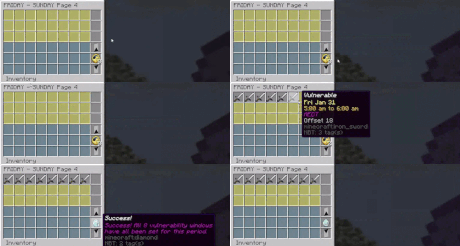
- Each slot is one hour of a day, and each day has its own colour.
- The Nether Star is now.
- Click an hour to toggle it.
- Iron swords are hours you are vulnerable.
- The number of clocks is how many hours you still need to set. When the clock becomes a diamond, you're done.
- The banners scroll between pages.
- Next week copies this week, and you can change it then.
- You cannot change the next 48 hours.
Attackers: the 30-minute prelude must end inside the defender's vulnerability window, so launch the attack before the window opens.
War camps and allies
War camps
- A war camp still spawns guards, but killing them does not affect the siege's health.
- The bar at the top of the screen is the siege's health. It drops slowly over time and whenever attackers respawn at the camp.
- How much it drops per attacker death depends on how many attackers are present.
- Large nations should use several war camps at once.
Joining a siege
- Any nation with a two-way alliance with either side can join. Its players just need to show up.
- To join the attackers, set up your own war camp, right-click its spawner and target the town.
- To join the defenders, just show up: you spawn at the defending town's default spawn. You can also set up a war camp if you prefer.
The battlefield
The siege zone
When a war camp launches an attack, a rectangle is drawn around the town and every war camp attacking it. This is the siege zone; the bar at the top of the screen shows when you're inside it.
- An attacker must always be in the siege zone. If every attacker leaves it, the attackers lose.
- When another war camp joins the attack, the zone grows to include it.
Death and spawning
- Attackers respawn at their war camp, which is block-protected and spawns guards. If your nation has no camp, you're sent to an allied one.
- Defenders can set a personal spawn anywhere in town with
/town spawn, and the town's default spawn with/town default-spawn. - During a siege your allies also spawn at your town spawn, unless they have a camp. Don't trap them inside your town: a camp inside your own town gives allies somewhere to spawn and an Exit Portal home.
- The starter exploration camp does not work in a siege: it won't function inside a siege zone or respawn you there.
Blocks, chests and items
- When the prelude ends, the town's protection is reduced but not removed. Attackers can break soft blocks with tools, more slowly than usual. Hard blocks need explosives.
- Any block placed during the siege counts as a soft block.
- Attackers may not place redstone blocks in the town, or blocks above the town's highest block.
- Chests and doors can't be destroyed by explosives. A chest broken by an attacker drops nothing and comes back after a few minutes.
- Attackers can't open chests, but can open the silos once they defeat the Nexus. The silos always hold items for attackers, even if the defenders emptied them.
Hard and soft blocks
Hard blocks (explosives only)
- Sandstone
- End Stone
- Quartz
- Dripstone Blocks
- Wood Planks
- Any block with an explosion resistance above 1 and below 100 (unless listed as soft)
Soft blocks (tools work)
- Dirt, Sand, Glass
- Shulker Boxes, Cobwebs, Lanterns
- Dried Kelp, Cocoa
- Iron, Diamond, Gold, Emerald and Coal blocks
- Obsidian (explosives also work)
- Chests (they drop nothing and respawn)
- Any block placed during the siege, shulkers included
Casus Belli
Wars on Pactoria are meant to be driven by diplomacy and roleplay, so that every war is meaningful rather than arbitrary. The Casus Belli system decides what counts as a valid reason for war: a nation must meet specific criteria, or check marks, before its declaration is accepted. You do not need a Casus Belli to attack an outpost.
Read more on the Casus belli page.
See also: Guard Towers to defend your town, and Siege Weapons to break into theirs.
Imported from https://wiki-beta.pactoria.net/w/index.php?title=Siege+%26+Wars (MediaWiki). Check the source's licence.